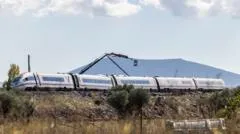
The Spain rail fraud probe has been launched by the European Public Prosecutor's Office (EPPO) following the deadly Urda train crash. Prosecutors are investigating the potential misuse of European Union funds intended for the renovation and upgrading of safety, signalling, and communications systems on the Madrid-Seville high-speed railway line. This inquiry follows a series of fatal accidents on the same line, including a crash in January that killed 46 people. Investigators are currently conducting measures at the offices of the Adif rail infrastructure authority and the rail safety agency AESF to determine if allocated EU resources were diverted or mismanaged.
The scope of the EPPO investigation into Spanish railway authorities
The European Public Prosecutor's Office (EPPO) has initiated investigative measures targeting the potential mismanagement of EU financial resources allocated to Spain's high-speed rail infrastructure. The probe specifically focuses on funds designated for the upgrading of safety, signalling, and communications systems on the Madrid-Seville high-speed line. According to the EPPO, the investigation is centered on whether these funds were used appropriately for their intended purpose of enhancing railway security and operational reliability.
The investigation involves high-level oversight from a special unit of Spain's Guardia Civil security force. To ensure legal compliance, a Spanish judge has been assigned to the case to oversee all investigative actions. This judicial oversight is required to authorize any measures that may infringe upon legal safeguards, such as conducting house searches or implementing phone-tapping protocols. The EPPO has noted that the case is of high public interest, though the agency has declined to release further specific details at this stage of the inquiry.
Technical failures leading to the Urda disaster
The Urda train crash, which occurred on 28 October, was precipitated by a critical failure in the LZB communication system. This system is responsible for monitoring the position of trains to prevent collisions. On the day of the accident, the LZB system went down, resulting in a loss of real-time positioning data for the high-speed line near Urda, located approximately 130km (80 miles) south of Madrid.
The sequence of events involved a Renfe-operated train, a state-owned entity, colliding with the rear of a stationary train owned by the private company Iryo. Because the communication system had failed, the Renfe train was given the all-clear to proceed at normal speed, despite the fact that the Iryo train ahead had been unable to restart following its own technical issues. This technical breakdown resulted in 69 fatalities, marking it as one of the most significant railway disasters in Europe during this century.
Comparative analysis of recent high-speed line accidents
The Urda disaster is not an isolated incident on the Madrid-Seville line. Within a nine-month period, two major accidents have occurred on this specific corridor, leading to a significant loss of life and public trust. The following table summarizes the two recent fatal incidents reported on this line:
| Incident Location | Date | Fatalities | Primary Context |
|---|---|---|---|
| Adamuz | January 2026 | 46 | High-speed line accident |
| Urda | 28 October 2026 | 69 | Collision with stationary Iryo train |
Collectively, these two accidents have claimed 115 lives and caused dozens of additional injuries, prompting intense scrutiny of the safety protocols and the management of the infrastructure upgrades funded by the EU.
Political consequences and leadership changes in Spain
The recent railway disasters have triggered significant political instability within the Spanish government, led by Prime Minister Pedro Sánchez. The accidents have occurred amidst a period of political division, with the Socialist-led government currently trailing the conservative People's Party (PP) in most opinion polls ahead of the general election scheduled for 29 November. The fallout from the Urda crash has intensified calls for accountability at the highest levels of government.
Following the death toll from the Urda disaster, the Spanish transport minister, Óscar Puente, resigned from his position. Puente's departure followed his oversight of both the January Adamuz accident and the October Urda accident. While his resignation was a direct consequence of the safety failures, opposition leaders from the People's Party (PP) and the far-right Vox party have argued that the resignation is insufficient. These political groups have demanded the resignation of Prime Minister Sánchez as well, linking the infrastructure safety failures to broader governmental responsibility.
Restoring public confidence and the path to safety reform
The Spanish railway system is facing a crisis of confidence, evidenced by reports of widespread cancellations and empty station platforms as passengers become increasingly wary of high-speed rail travel. The newly appointed transport minister, Carlos Cuerpo, has made the restoration of public trust a primary objective. Cuerpo has publicly vowed to implement all necessary measures to rebuild the confidence of Spanish citizens in the high-speed rail network.
In an effort to address the systemic issues identified by survivors and safety advocates, Cuerpo has engaged directly with those affected by previous tragedies. On Friday, the new minister met with survivors of the January Adamuz disaster. During this meeting, the survivors presented a formal list of 11 specific demands aimed at improving safety standards across the Spanish railway network. These demands represent a direct push for structural changes in how rail safety and infrastructure are managed in the wake of the EPPO's fraud investigation.