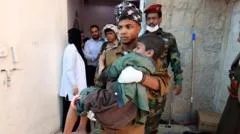
A Saudi air strike in Yemen has killed at least 33 people, including women and children, according to media linked to the Houthi movement. The attack targeted the town of al-Shariyah, located east of the capital, Sanaa, on Saturday. The Saba news agency, operated by the Houthis, reported that 39 other people were injured during the strike. Local officials noted that the casualties include several minors. As of Sunday, the Saudi-led coalition backing Yemen's internationally recognised government has not issued a comment regarding the incident.
Casualties and destruction in al-Shariyah
At least 33 individuals were killed during the strikes on al-Shariyah, with reports indicating that the victims included women and children. Live video footage broadcast by Al Masirah, a television station run by the Houthi movement, documented rescuers extracting bodies from the rubble of several destroyed buildings. The footage specifically showed the bodies of young children among the deceased recovered from the ruins.
The scale of the human toll was further detailed by the Houthi-run Saba news agency, which confirmed that 39 people sustained injuries in the attack. In addition to the fatalities, the television station aired images of numerous injured persons being transported to hospitals on stretchers. The destruction of residential or civilian structures in the town remains a central focus of the Houthi media's reporting on the event.
Visual evidence and hospital reports
The visual documentation provided by Al Masirah has been instrumental in the Houthi movement's communication of the strike's impact. By showing rescuers working amidst the debris, the station has emphasized the immediate humanitarian crisis in al-Shariyah. The presence of children's bodies in the footage serves to highlight the civilian nature of the casualties reported by the movement.
Escalation of the Yemen conflict and regional triggers
The recent surge in violence follows a period where the war in Yemen had been relatively dormant for several years. This instability has been attributed to the broader regional tensions stemming from the Iran war. A critical turning point in the current escalation occurred when a truce began to disintegrate following a Saudi strike on the airport in Sanaa. The Saudi-led coalition targeted the airport, which is under Houthi control, in an effort to prevent the landing of an Iranian aircraft.
In response to the airport strike, the Tehran-backed Houthi movement initiated a series of retaliatory measures. These included targeting Abha airport within Saudi Arabia and launching attacks on Saudi vessels in the Red Sea. These maritime attacks have specifically targeted ships utilizing the Red Sea as an alternative oil export route to bypass the Strait of Hormuz. This cycle of aerial and maritime strikes has led to a resumption of major fighting between the Houthis and the forces supporting the internationally recognised government of Yemen.
Recent patterns of violence and civilian impact
The strike in al-Shariyah is part of a broader pattern of recent lethal incidents across Yemen. On the Friday preceding the al-Shariyah attack, a strike on a market in Taiz province was reported to have killed 30 people. However, the responsibility for that specific incident remains a point of contention between the warring parties. While the Houthis accused Saudi forces of carrying out the market strike, government forces claimed the casualties were the result of a Houthi missile hitting the site.
The humanitarian consequences of this renewed fighting are substantial. According to the United Nations, the resumption of hostilities has resulted in more than 1,600 deaths and the displacement of over 300,000 people. The conflict continues to involve high-intensity strikes from both sides, with the Saudis regularly bombing Houthi positions and the Houthis firing missiles at targets within Saudi territory, including oil facilities and airports.
Military developments and retaliatory threats
Military activity has intensified in the hours leading up to the strikes in al-Shariyah. The Saudi-led coalition reported that it had successfully intercepted a missile heading toward Riyadh shortly before the attack on al-Shariyah took place. While the missile was intercepted, the Saudi Ministry of Energy confirmed that an Aramco tower was struck by falling shrapnel during the attempted attack.
The Houthi leadership has signaled that the recent strikes will lead to further military action. Mahdi al-Mashat, a Houthi leader, has publicly vowed that the group will seek revenge for the latest attacks conducted within Yemen. This rhetoric suggests that the cycle of strikes between the Saudi-led coalition and the Tehran-backed movement is likely to continue as both sides respond to recent developments in the theater of war.
| Location of Incident | Reported Casualties | Attribution/Context |
|---|---|---|
| al-Shariyah | 33 killed, 39 injured | Reported by Houthi-run Saba news agency |
| Taiz province market | 30 killed | Disputed: Houthis blame Saudis; Government blames Houthi missile |
| Yemen (Overall since resumption) | 1,600+ killed | United Nations figures |