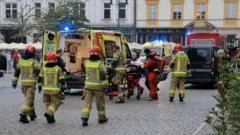
The Krakow shooting in Poland's historic centre resulted in six deaths and 15 injuries after a gunman opened fire near the Main Market Square on Saturday. A 24-year-old Polish attacker, who remains in critical condition, is the primary suspect in the mass shooting. Polish authorities have launched a terror investigation into the incident, which ministers suggest was motivated by far-right ideologies. The attack involved a suspect in military tactical gear using a military-grade weapon, causing significant chaos and casualties among bystanders and law enforcement.
Immediate medical response and life-saving interventions
Two surgeons, Professor Michal Pędziwiatr and Dr Mateusz Wierdak, provided critical emergency care on the streets of Krakow immediately following the gunfire. The medical professionals were having lunch with their families near the Main Market Square when the shooting began. According to local media reports, Pędziwiatr was alerted to the danger by his son, who observed people being shot and falling to the ground.
The surgeons divided their efforts between treating the victims and the perpetrator. While Pędziwiatr focused on the other casualties and the attacker, Dr Wierdak provided emergency stabilization for a police officer who had sustained a gunshot wound to the chest. Dr Wierdak described the necessity of immediate intervention, noting that he applied bandages and manual pressure to the officer's chest due to a significant delay in ambulance arrival.
To ensure the best possible surgical outcome for the critically injured, Pędziwiatr coordinated with the John Paul II Hospital. He specifically requested that the injured officer be transported to the hospital's Department of Thoracic and Cardiac Surgery, noting that the facility's specialists were best equipped to handle such specific trauma. The University Hospital in Krakow identifies Pędziwiatr as the head of General, Oncological, Metabolic and Emergency Surgery.
Casualties and identities of those affected
The shooting resulted in a diverse group of casualties, including both Polish citizens and foreign nationals. Among the six people killed were a British national and an Austrian woman, alongside four Polish citizens. The 15 injured individuals included two police officers, senior constables Jakub Kulik and Artur Morański, who were shot while attempting to subdue the gunman.
The two officers, who were hailed as "true heroes" by the Polish Prime Minister for preventing further loss of life, both emerged from comas on Sunday. Following their recovery, the Mayor of Krakow submitted an urgent request to award both Kulik and Morański the title of honorary citizen of the city.
| Category | Details |
|---|---|
| Fatalities | 6 (including 1 British, 1 Austrian, 4 Polish) |
| Injuries | 15 (including 2 senior constables) |
| Suspect Status | 24-year-old male, critical condition |
| Investigation Type | Terrorist offences |
Terror investigation and suspect profile
The National Public Prosecutor's Office in Poland has initiated a formal investigation led by a unit specializing in terrorist offences. This follows statements from government ministers suggesting the 24-year-old attacker was inspired by far-right ideologies. Poland's Interior Minister, Marcin Kierwiński, stated that everything suggests the suspect held ultra-nationalist views and was fascinated by far-right ideologies.
Suspect background and investigation findings
While the suspect's name has not been released by authorities, investigators have uncovered significant details during the initial phase of the probe. The attacker was observed wearing full military tactical gear and utilized a military-grade weapon during the three-minute rampage. Although the suspect's appearance suggested military involvement, the Polish government clarified that he was not a member of the Polish armed forces.
A search of the suspect's residence yielded further grim findings, as the bodies of his parents and sister were discovered inside the home. The investigation is currently focusing on the link between the suspect's ideological leanings and the premeditated nature of the attack, which involved the suspect's vehicle speeding through the city centre before the shooting commenced.
Witness accounts and the scene in Krakow
Witnesses described a scene of intense panic and confusion in the historic centre as the shooting unfolded shortly before 15:00 local time. The attack lasted approximately three minutes and caused widespread damage, including shattered shop fronts and a shot tram. Bystanders reported fleeing for their lives as gunfire echoed through the square.
Ruby Catherine Warren, a resident from London, described the immediate impulse to run after hearing the shots, noting that she and her friends sprinted to find a hotel for safety. Tom Brook, a visitor from West Yorkshire, witnessed the aftermath from a nearby McDonald's, describing seeing paramedics working on a victim and a body covered in foil blankets approximately 20 metres away.
In addition to the local medical response, six Dublin Civil Defence volunteers were present in the area. These volunteers, who were on a city break near the main square, provided immediate medical assistance. James McConnell, an officer with the group, told RTE News that the volunteers utilized their training to provide CPR and haemorrhage control to those injured in the square.