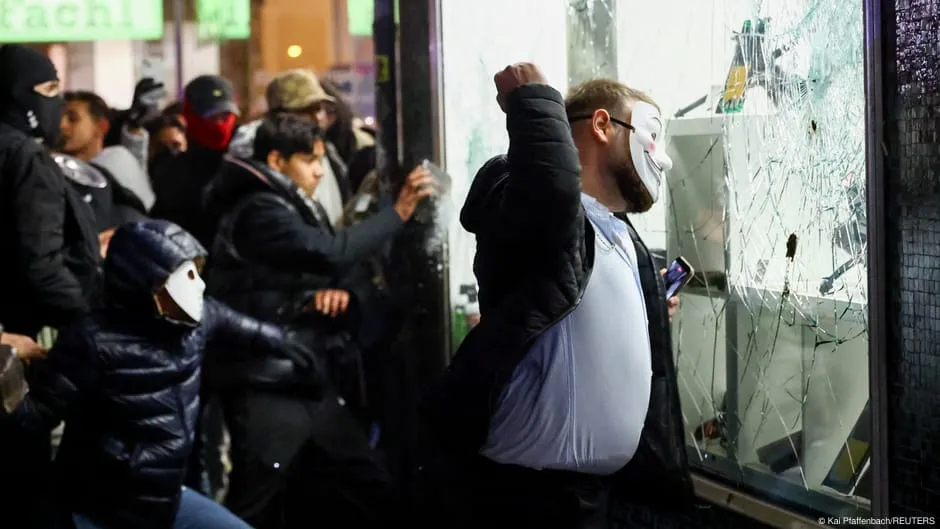
Gen Z protests in Germany have transitioned from peaceful demonstrations into a heated political debate regarding integration and social bias following violent riots in several cities. While the 'Gen Z regelt' initiative initially sought to address climate action and housing, clashes in Frankfurt, Cologne, Hamburg, and Berlin resulted in significant property damage and injuries to over 100 police officers. The German government is now divided over whether the violence should be attributed to specific migrant groups or if such labels reinforce harmful prejudices against German citizens with migration backgrounds.
The escalation of violence during peaceful demonstrations
Violent street battles erupted in Frankfurt on October 31 following demonstrations that were intended to be predominantly peaceful. According to reports, more than 100 police officers were injured during these clashes, with one officer sustaining severe injuries. Beyond the physical toll on law enforcement, the unrest led to widespread looting and damage to local shops, including a weapon store in Frankfurt.
The scale of the unrest was not limited to a single location; similar escalations occurred in Cologne, Hamburg, and Berlin. These incidents followed a Saturday where tens of thousands of young people participated in rallies across the country. The movement, organized under the initiative 'Gen Z regelt' (meaning 'Gen Z takes charge'), had focused on several systemic issues facing the younger generation:
- Improved educational opportunities
- Affordable housing solutions
- Urgent climate action
While the core of the movement remains focused on these socio-economic concerns, the recent violence has shifted the national conversation toward security and social cohesion.
Political friction over the identity of offenders
The German federal government is currently experiencing a rift regarding how to characterize the individuals responsible for the recent rioting. Conservative lawmakers have focused on the background of the perpetrators, while center-left members warn that such framing risks marginalizing large segments of the population.
German Interior Minister Alexander Dobrindt and Hesse Interior Minister Roman Poseck have both pointed toward migrant backgrounds as a factor in the violence. Poseck, representing the CDU, noted that while most of those arrested were German citizens, "this group of offenders was predominantly from a migrant background." Dobrindt, a member of the CSU, further characterized the events as peaceful demonstrations that were "hijacked by violent left-wing groups and migrant hooligans."
Chancellor Friedrich Merz has supported these assessments. A spokesperson for Merz, Stefan Kornelius, stated that the Chancellor's view was based on observations from investigating authorities and emergency personnel on the ground, matching the visual evidence seen in media reports. Merz has signaled a zero-tolerance policy, stating in a speech prepared for a November 2 event in Berlin that attacks on police and shops constitute an attack on freedom and society itself.
The counter-argument from Social Democrats
The Social Democrats (SPD), who serve in a coalition with the CDU and CSU, have challenged the tendency to categorize the unrest through the lens of migration. Defense Minister Boris Pistorius addressed these distinctions during an interview with ZDF on November 1, emphasizing that the focus should remain on criminal conduct rather than ethnic or social labeling.
Pistorius specifically questioned the utility of the term 'migrant groups,' asking whether such a label includes third-generation residents who are full German citizens. He argued that drawing these distinctions leads the national conversation in the wrong direction. This sentiment is echoed by the federal government's integration commissioner, Natalie Pawlik, who told the Frankfurter Allgemeine Zeitung that attributing riots to 'migrant milieus' is an oversimplification that harms peaceful demonstrators and those serving in emergency services.
Integration challenges and demographic realities
The debate over integration is underscored by the demographic composition of Germany's urban centers. As the political discourse intensifies, officials are grappling with how to address social marginalization without inciting further resentment.
According to data from Germany's Federal Statistical Office (Destatis), approximately 31% of the German population has a migration background. This figure is significantly higher in major metropolitan areas; for instance, in Frankfurt, the proportion exceeds 50%. This demographic reality provides the context for the concerns raised by Family and Education Minister Karin Prien (CDU).
| Metric/Entity | Data/Position |
|---|---|
| National Population with Migration Background | 31% (Destatis) |
| Frankfurt Population with Migration Background | Over 50% |
| Minister Karin Prien's Position | Calls for examining integration success and preventing parallel societies |
| Minister Natalie Pawlik's Position | Urges focus on root causes like lack of prospects and marginalization |
Minister Prien has stated that while it is necessary to reflect on reality, stirring resentment is politically counterproductive. She argues that if perpetrators do indeed come from migrant backgrounds, it should serve as a catalyst to examine why integration has been less successful in certain groups and to facilitate better societal participation.
The future of the Gen Z regelt movement
As the government debates the causes of the unrest, the organizers of the Gen Z protests are fighting to maintain the focus on their original objectives. There is also an emerging tension regarding the legality of future demonstrations.
Hesse Interior Minister Roman Poseck has suggested the possibility of banning further Gen Z protests, citing concerns for social peace. He noted that organizers appear unable to maintain control over their gatherings, citing "massive attacks" against police even during demonstrations. However, the organizers have rejected these accusations, stating they have immediately distanced themselves from the violent incidents.
To address the underlying grievances of the youth, Minister Prien has scheduled meetings with representatives from the Federal School Students Council (BSK) and the German Education Union (GEW). This move aims to ensure that the legitimate demands of young people—such as housing and education—are not entirely lost to the security-focused debate. The movement has already signaled its intent to continue, with further demonstrations planned for November 20.