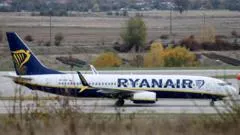
European airline bomb threats have escalated following a third wave of incidents in a single week, impacting multiple international flight paths. On Friday, flights to and from Lisbon, Rome, Prague, and Sofia were targeted, leading to three aircraft being escorted by Hungarian fighter jets. This latest surge follows earlier disruptions affecting nearly 30 aircraft and several European airports. While no explosives have been discovered, authorities are investigating whether these malicious hoaxes constitute a coordinated campaign of disruption across the continent.
Widespread aviation disruption across multiple European hubs
The latest wave of threats on Friday significantly impacted air travel logistics across several countries. A Ryanair flight scheduled to depart Lisbon for Rome was specifically targeted, according to the airline. Simultaneously, the Czech Republic and Bulgaria faced heavy disruption, with at least 11 flights receiving threats, as reported by AFP. France also recorded at least four targeted flights, though all aircraft involved landed safely without incident.
The scale of the disruption is reflected in the emergency responses required by various national authorities. In one instance, Hungarian fighter jets were deployed to escort three planes following the receipt of threats. As of Friday, no physical explosives have been located on any of the aircraft involved in these incidents.
Summary of Friday's reported aviation threats
| Region/Airline | Scope of Impact | Status/Notes |
|---|---|---|
| Lisbon to Rome (Ryanair) | 1 flight targeted | Reported by airline |
| Czech Republic & Bulgaria | At least 11 flights | Reported by AFP |
| France | At least 4 flights | Landed safely |
| General European Hubs | 3 planes escorted | By Hungarian fighter jets |
Coordinated campaign targeting media and transport sectors
Authorities are investigating a potential link between the aviation threats and simultaneous security warnings issued to major media organizations. Several high-profile broadcasters and newspapers were forced to evacuate their premises following threats. In Ireland, RTÉ, the public broadcaster, evacuated its buildings, while staff at the Irish Independent newspaper and the Dublin offices of radio stations NewstalkFM and TodayFM were advised to leave. The UK broadcaster Sky also confirmed it had received a security threat.
While no concrete link has been established between the messages sent to airlines and those sent to broadcasters, the Irish government has expressed concern regarding a pattern of behavior. The government warned that these incidents appear to be a "likely coordinated campaign of disruption." This assessment comes as Ireland prepares to host two high-profile European Union meetings in Dublin next week.
Sky, which is owned by Comcast, addressed the situation through a statement read by a presenter on its news channel. The broadcaster stated it had "carried out a security assessment and reported the matter to the relevant authorities," emphasizing that the safety of their colleagues remains their primary concern while working with authorities to secure operations.
Government response and official statements on security
Irish Prime Minister Micheál Martin described the current security environment as "worrying," noting that the government's priority is the safety of the Irish public. Addressing the pattern of incidents, Martin told RTÉ that while it was not yet confirmed if the threats originated from individuals or represented a "coordinated attack," the government is treating the matter with extreme seriousness.
The Irish police (gardaí) confirmed they are aware of the threats made against both media organizations and European entities. The official stance from the Irish government emphasizes the non-constructive nature of these actions. In a formal statement, the government noted: "Hoax threats such as these cause fear, distress and disruption to people going about their daily lives and activities; they achieve no positive purpose whatsoever."
The investigation continues to focus on the source of the messages. Authorities are currently unable to determine if the responsibility lies with a centralized group or a series of disconnected individuals. This uncertainty follows an earlier week where nearly 30 aircraft and several airports across Europe were impacted by what the UK government characterized as a "malicious hoax."
Denials from extremist groups regarding involvement
The Russian extremist group "Male State" has denied any connection to the recent wave of hoax bomb threats. The group had been named in relation to threats made against Italian airports earlier in the week. Despite the allegations, the group has moved to distance itself from the electronic communications used to issue the warnings.
In a response to the BBC Russian Service, an account on Telegram linked to the group and its founder, Vladislav Pozdnyakov, mocked the suggestion of their involvement. The message on the channel stated: "What Male State? Where have you seen it? It hasn't existed for many years." The account further dismissed the inquiry by stating, "If tomorrow they sign a [threat] letter, say, from Putin, will you then try to reach our president to ask your stupid question?"
The denial highlights the difficulty authorities face in attributing these digital threats to specific actors. As the investigation progresses, the distinction between organized extremist activity and decentralized malicious hoaxes remains a central point of inquiry for European security services.