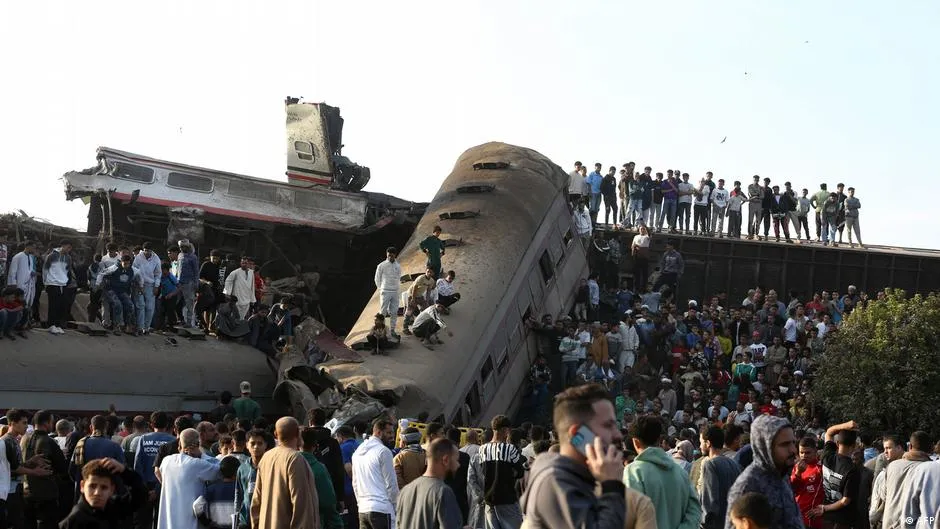
An Egypt train crash near Cairo has resulted in at least seven deaths and left more than 100 passengers injured. The collision occurred on Sunday in the Giza province, involving a train that struck the rear of another vehicle on the line connecting Cairo to Aswan. Emergency services responded to the scene to manage the casualties and clear the derailed wreckage from the tracks. Local officials confirmed that rescue teams are working to reach those trapped within the carriages. Investigators are currently examining the signaling systems to determine the cause.
Collision details and emergency response in Giza
The accident took place in the al-Ayyat district of Giza, approximately 52 kilometers (32 miles) south of Cairo. According to Egyptian authorities, the collision involved one train striking the rear end of another train traveling on the route between Cairo and the southern city of Aswan. The impact caused one of the trains to derail, leading to several passenger cars flipping over.
Emergency response efforts were significant following the impact. Officials confirmed that 52 ambulances were deployed to the site to treat the more than 100 injured passengers. In addition to medical personnel, rescue teams and cleanup crews were mobilized to the scene. Heavy equipment, including cranes, was utilized by emergency crews to clear the railway line and attempt to restore traffic through the affected Giza district.
Incident Summary
| Category | Details |
|---|---|
| Location | al-Ayyat district, Giza province |
| Distance from Cairo | 52 kilometers (32 miles) south |
| Confirmed Fatalities | At least seven |
| Reported Injuries | Over 100 |
| Ambulances Deployed | 52 |
Government investigation and accountability orders
Following the collision, Egyptian President Abdel-Fattah el-Sissi announced that a formal investigation into the cause of the crash has been ordered. While the specific technical or human cause of the collision was not immediately clear at the time of the report, the presidency has emphasized the need for a thorough inquiry.
In a statement shared via social media, President el-Sissi directed state agencies to ensure strict accountability regarding the incident. He specifically urged officials to "hold accountable anyone found to have been negligent." This directive comes as authorities work to determine whether the crash was a result of mechanical failure, signaling errors, or other operational lapses on the Cairo-Aswan line.
Historical context of railway accidents in the region
The site of this collision shares a grim connection with previous major rail disasters in Egypt. The accident occurred in the same general area as the deadliest train disaster in the country's history. In 2002, a massive train fire in this region resulted in the deaths of over 370 people.
The region has also seen other significant safety failures in the past decade. According to reports, several other crashes in the same area claimed dozens of lives in 2009. These recurring incidents highlight the persistent challenges facing the nation's transportation infrastructure despite ongoing modernization efforts.
Infrastructure modernization and ongoing safety challenges
Egypt is currently in the midst of a large-scale effort to overhaul its transportation network. The government has invested billions of dollars into developing new highways and implementing high-speed rail lines across the country. These projects are intended to modernize the aging rail network and improve connectivity between major urban centers.
However, the recent collision underscores that these investments have not yet fully mitigated the risks associated with the existing system. While the new high-speed lines represent a significant technological shift, the country continues to face safety issues and repeated crashes as it attempts to manage and revamp its older, legacy rail infrastructure. The transition from an aging network to a modernized system remains a critical point of vulnerability for the national transport sector.