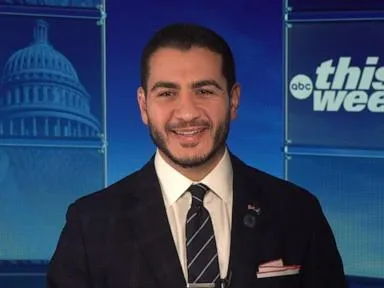
Michigan senator-elect Abdul El-Sayed stated on Sunday that Democrats are willing to cooperate with President Donald Trump if the president adopts a serious approach to governance. Speaking in an exclusive interview on ABC News' "This Week," El-Sayed characterized the president as an "unserious fool" regarding specific policy directions, including potential conflicts in Iran and tariff disputes with Canada. While expressing skepticism toward the current administration's trajectory, the incoming senator indicated a readiness to negotiate on key legislative goals such as healthcare and campaign finance reform.
Legislative cooperation and criticisms of the Trump administration
Senator-elect Abdul El-Sayed maintains that his willingness to work with the White House is contingent upon the president's commitment to serious policymaking. During his interview with ABC News, El-Sayed identified several areas where he believes the administration has demonstrated a lack of seriousness, specifically citing foreign policy and economic measures.
El-Sayed highlighted the potential for conflict in Iran and economic volatility stemming from trade disputes. "Let's talk about how he is an unserious fool. Think about this war in Iran that every single president had resisted fighting because, of course, it was a dumb idea," El-Sayed told ABC "This Week." He further criticized the administration's approach to trade and social safety nets, noting the "foolishness of a tariff war with Canada" and the potential for "gutting Medicaid to pass tax cuts for the richest people in America."
The senator-elect also addressed the recent changes in the White House leadership structure. President Trump announced on Friday that Stephen Miller would assume the role of chief of staff, effective Monday, replacing Susie Wiles. El-Sayed linked this personnel shift to the president's overall governing style, stating that if the president chooses to continue a pattern of "foolishness," he will likely continue to employ staff such as Miller.
Policy friction and personnel shifts
The transition in the White House chief of staff position represents a significant shift in the administration's internal management. By appointing Stephen Miller to replace Susie Wiles, the president is signaling a specific ideological direction for the incoming term. El-Sayed suggested that this choice is emblematic of the president's broader approach to governance, implying that the selection of personnel is a direct reflection of whether the administration intends to pursue serious policy or continue what El-Sayed describes as a period of instability.
Core campaign priorities and the 'Trump Medicare for All' proposal
Abdul El-Sayed intends to use his position in the Senate to advance three primary legislative pillars: reforming campaign finance, increasing consumer purchasing power, and implementing universal healthcare. Despite his criticisms of the president, El-Sayed proposed a provocative method for achieving healthcare reform through bipartisan or even administration-led action.
The senator-elect's platform focuses on the following objectives:
- Money out of politics: Reducing the influence of large donors and special interests in the electoral process.
- Money in pockets: Implementing economic policies designed to increase the disposable income of American citizens.
- Medicare for All: Passing comprehensive legislation to guarantee healthcare coverage to the entire population.
In a notable rhetorical move, El-Sayed suggested he would support a version of universal healthcare if it were branded under the administration's name. "I've said this, if he wants to pass Trump care for all, which will guarantee health care to everyone and put his name on it like he's putting his name on everything, I'm game," El-Sayed remarked. This approach underscores his primary goal of securing healthcare access, even if it requires unconventional political maneuvering.
Democratic leadership and the path to Senate majority
As the incoming senator prepares for his term, the question of Democratic leadership in the Senate remains a focal point of political discussion. El-Sayed has expressed dissatisfaction with the current state of legislative productivity and is looking for a leader capable of immediate action. While he has worked with Senate Minority Leader Chuck Schumer during his campaign, he has not committed to supporting Schumer in any bid for majority leadership.
El-Sayed's stance on leadership is defined by a desire for results rather than institutional continuity. He noted that while he and Schumer "figured out how to work together," his priority is identifying a leader who can deliver on the Democratic mandate. He specifically mentioned Maryland Senator Chris Van Hollen as a figure of interest, though Van Hollen has not publicly declared an intention to seek the majority leadership position.
| Leadership Criteria | El-Sayed's Requirement |
|---|---|
| Action Orientation | Must be ready to take action on "day one." |
| Legislative Focus | Must prioritize Medicare for All and campaign finance reform. |
| Historical Performance | Must improve upon past legislative output. |
The senator-elect's comments suggest a potential period of internal debate within the Democratic caucus regarding the direction of its leadership and its ability to respond to the incoming administration's policies.
The historic significance of the Michigan Senate victory
The election of Abdul El-Sayed marks a significant milestone in American political history, as he is set to become the first Muslim senator in the United States. His victory in Michigan followed a highly competitive and contentious primary against fellow Democrat Haley Stevens, as well as a general election battle against former Republican Representative Mike Rogers.
A defining issue throughout his campaign was U.S. support for Israel. El-Sayed has maintained a position as a staunch critic of the Israeli government and has consistently opposed U.S. military aid to the country. This stance was a central component of his political identity and a major point of contention during both the primary and general election cycles.
Personal journey and political inspiration
El-Sayed's path to the Senate is rooted in a personal narrative of overcoming perceived barriers to political participation. He recounted an anecdote from 2007, when he was a college graduate, during which commencement speaker Bill Clinton encouraged him to run for office. At the time, El-Sayed was skeptical of his own prospects due to his background.
"I laughed in his face. I said, 'Mr. President, I don't know if you saw my name. It's got 11 letters in it. People like me don't get to run for office,'" El-Sayed recalled. He credited the subsequent election of Barack Obama in 2008 as the catalyst that changed his perspective on what was possible for individuals from his community. He noted that both Clinton and Obama saw potential in him that he had not yet recognized himself, a realization that eventually led to his historic win in Michigan.